
01
Separate the operating systems
Treat the door, lifting hardware, guide hardware, and powered controls as connected but testable systems. In a garage door services assessment, the starting condition is a door problem that has not yet been narrowed to one component. Identify whether the change appeared suddenly, developed over several cycles, or followed an impact, obstruction, power interruption, or manual release.
The relevant chain includes movement, balance, lifting hardware, controls, panels, and weather seals. Each group can alter how the others behave, so the visible symptom is evidence, not a final diagnosis. This keeps secondary damage from being mistaken for the original cause.
For this topic, the assessment objective is to route the symptom to the right service category without guessing. If the door is hanging, crooked, jammed, or carrying weight unevenly, stop movement and preserve the position for a safe inspection rather than trying another cycle.
02
Observations that narrow the problem
Record which control initiated the last successful cycle. Then describe how garage door services affects opening and closing separately. A motor sound without door travel, one side moving ahead of the other, or a reversal at a repeatable location each points the evaluation toward a different relationship among movement, balance, lifting hardware, controls, panels, and weather seals.
Timing gives the observation context. A change at startup loads different parts than a change near the top of travel, while a problem close to the floor can involve contact, travel limits, seals, or the safety system. Apply that timing specifically to a door problem that has not yet been narrowed to one component.
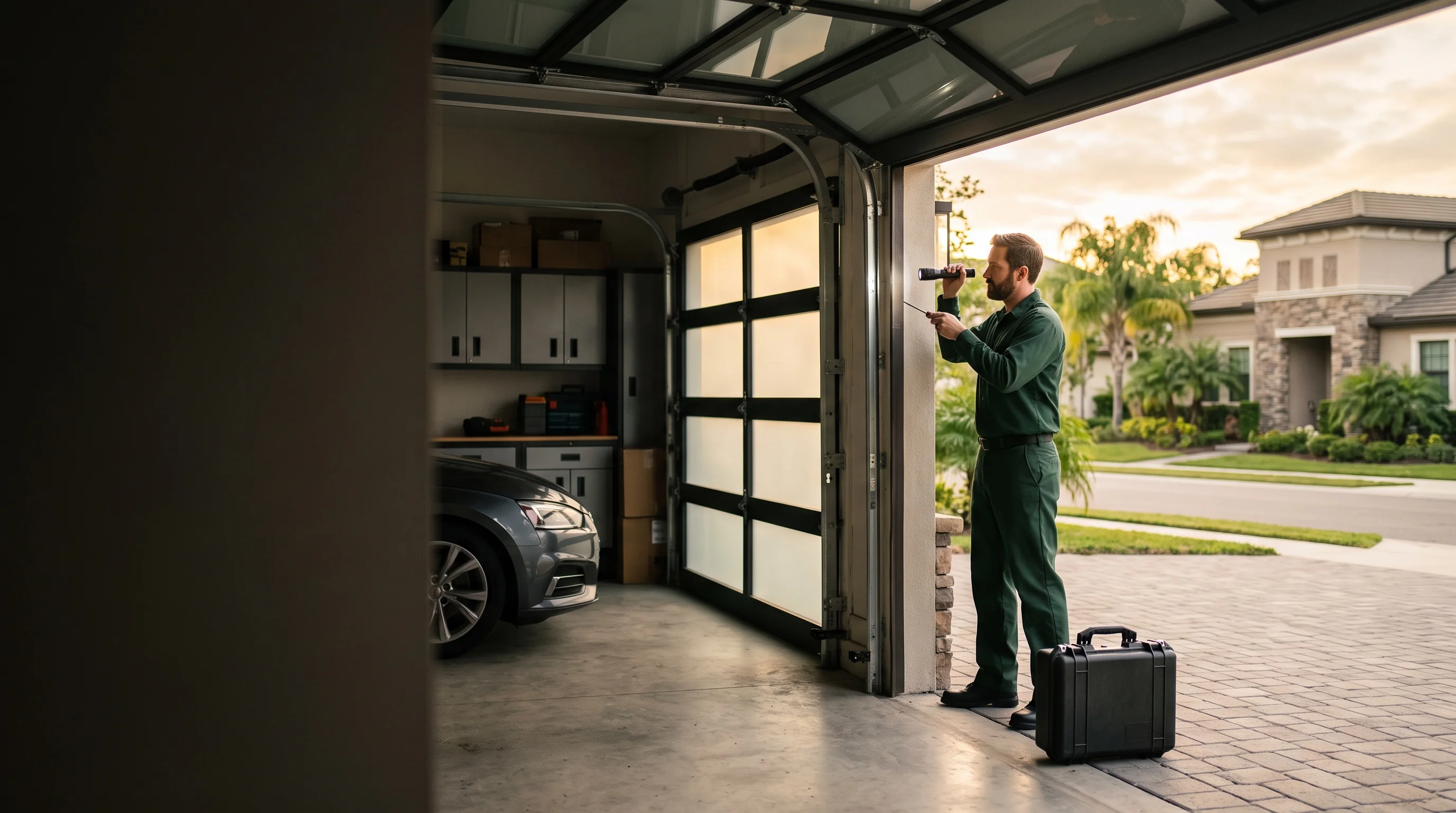
Images should document, not investigate. Photograph the complete door, the visible track path, and any obvious change associated with garage door services from stable ground. Never reach toward spring coils, cable drums, bottom brackets, or an unsupported section to improve the picture.
03
How components are evaluated together
The evaluation of garage door services begins by checking the interfaces among movement, balance, lifting hardware, controls, panels, and weather seals. The intention is to route the symptom to the right service category without guessing, then determine whether the observed condition is a cause, a consequence, or an unrelated maintenance item.
Counterbalance, alignment, and resistance provide the mechanical baseline. An opener cannot be evaluated fairly against a binding or unusually heavy door; similarly, work on guides or controls cannot compensate for unstable lifting hardware. The baseline must fit the specific behavior: a door problem that has not yet been narrowed to one component.
Related wear matters most where load has shifted. Evidence on one hinge line, one cable path, one track face, or one set of rollers can explain why garage door services emerged on one side first. That evidence helps keep the scope connected to the actual force path.
04
Repair scope versus broader replacement
A focused garage door services repair is easier to justify when the surrounding movement, balance, lifting hardware, controls, panels, and weather seals remain stable, compatible, and capable of normal adjustment. A broader plan deserves consideration when the same fault returns, damage crosses component groups, the opening no longer fits, or required matching parts are unavailable.
The comparison should state what remains after the work. If the proposal addresses a door problem that has not yet been narrowed to one component but leaves another known source of resistance, imbalance, or control failure, the future condition is not yet clear. That is more useful than assuming every older door needs replacement or every isolated fault should be repaired.
Request a component-level scope for garage door services: what is being corrected, what related interfaces will be checked, what safety functions will be tested, and how the completed system will be observed. This makes competing approaches easier to compare without relying on unsupported promises.
05
Safety limits for homeowner checks
For garage door services, homeowner observations should remain visual and external. Door position, visible impact, control response, obvious floor obstructions, and changes in sound can be recorded without dismantling movement, balance, lifting hardware, controls, panels, and weather seals. Even a simple check should stop if the door changes position unexpectedly.
Do not loosen springs, drums, cables, bottom brackets, loaded hinges, or structural track supports while investigating a door problem that has not yet been narrowed to one component. Never bypass photo eyes, defeat reversal behavior, force a displaced roller, or disconnect an opener from a hanging or unsupported door.
Clear the travel area and keep people, pets, and vehicles away until the garage door services condition is stable. When access is blocked or a vehicle is trapped, place that fact near the beginning of the request so the situation can be planned without improvised lifting or forced movement.
06
Prepare a useful assessment request
A strong garage door services request includes when a door problem that has not yet been narrowed to one component first appeared, the current door position, and the last action that completed normally. Add any recent impact, power interruption, remote programming, manual operation, or weather exposure that changed the sequence.
Describe only what is visible across movement, balance, lifting hardware, controls, panels, and weather seals. State whether one side is higher, a roller has left a track, a cable appears slack, a section is bowed, or an indicator light has changed. Avoid moving a component merely to see whether it is loose.
The request does not need to diagnose garage door services. Its job is to support the goal to route the symptom to the right service category without guessing by preserving accurate observations and identifying immediate access or safety constraints. The final scope can then follow evidence from the complete system assessment.
Useful observations
What to note before requesting help
- Current door position and whether it is stable
- Whether the problem happens while opening, closing, or both
- Which wall control, remote, or keypad responses still work
- Any visible track, roller, cable, panel, or sensor change
- The timing and location of any new sound
- Any recent impact, obstruction, power loss, or manual operation
Straight answers
Questions about this issue
Can I keep using the door while investigating garage door services?
Stop using the door if it is crooked, hanging, off track, jammed, supported unevenly, or showing a loose cable or damaged spring. A stable control issue may allow limited observation, but repeated cycling should not be used as a diagnostic method.
What information is most useful in an assessment request?
Include the door position, the direction of travel when the problem appears, which controls respond, any visible damage, recent impacts or power changes, and whether a vehicle is trapped.
Should I pull the emergency release?
Not when the door is hanging, crooked, partly supported, or suspected of having spring or cable damage. Releasing the opener can allow an unsupported door to move suddenly.
Does one symptom identify the failed part?
Usually not by itself. Similar symptoms can come from the door, counterbalance system, tracks, rollers, controls, sensors, or opener, so the systems need to be separated during assessment.